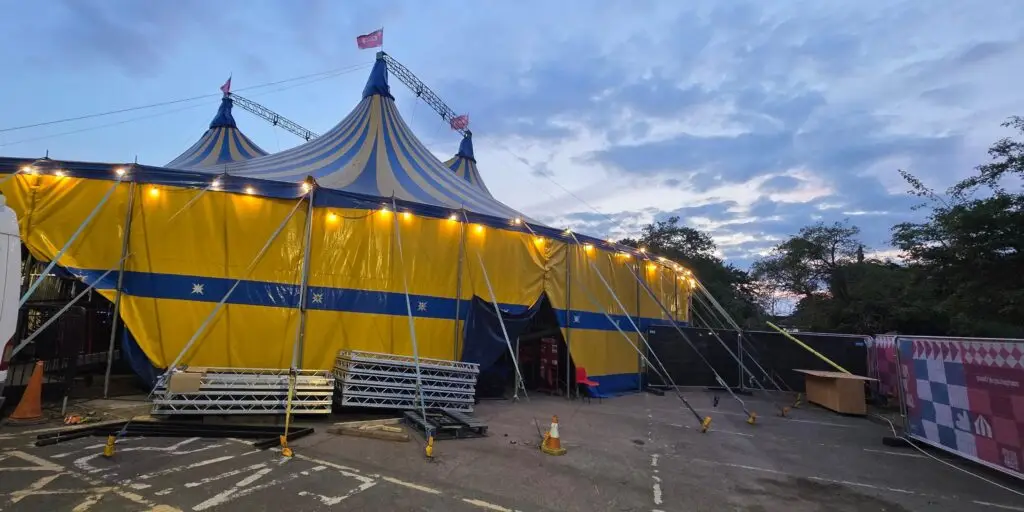
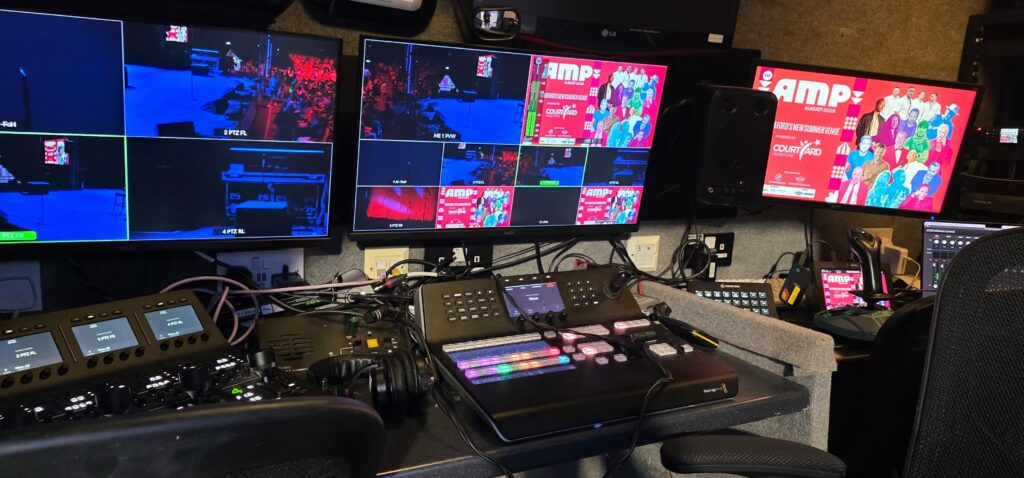
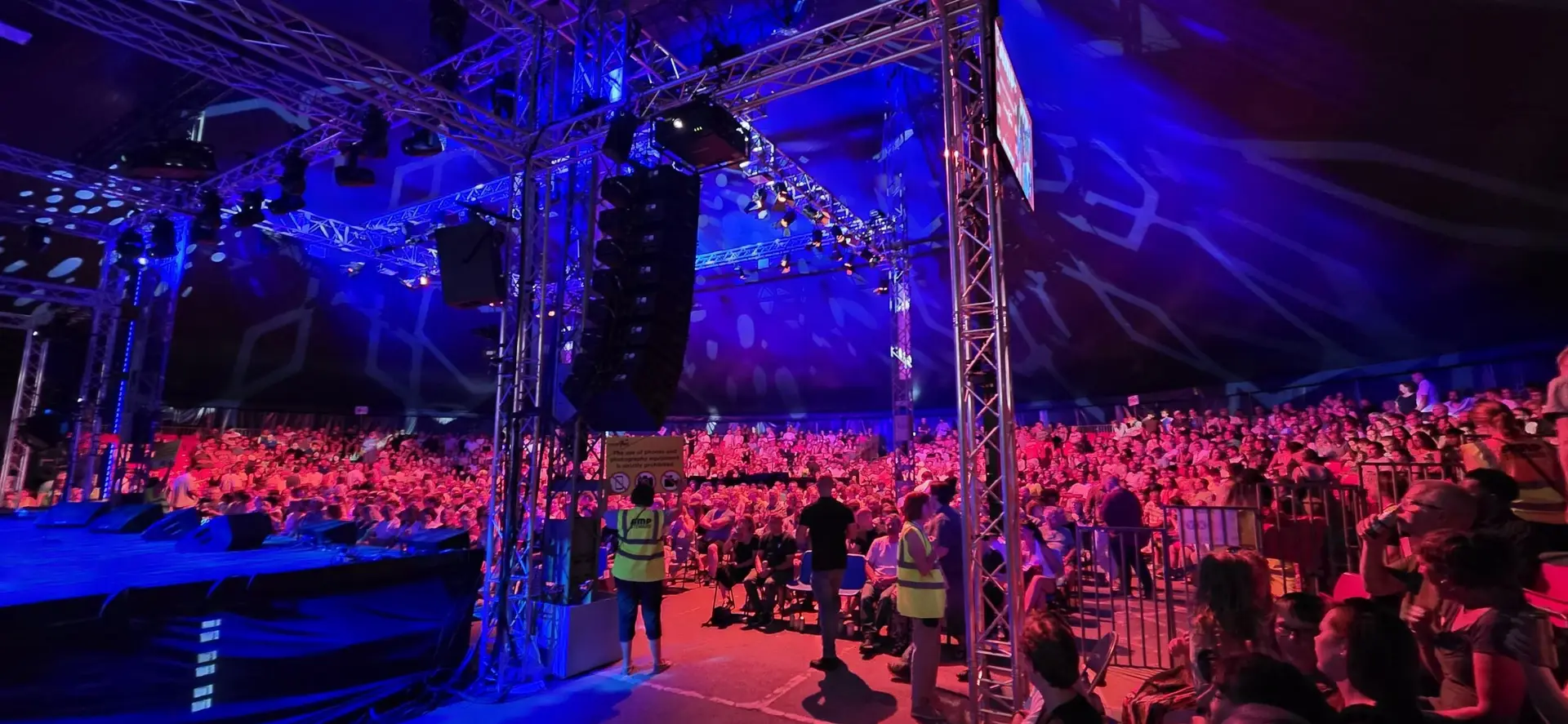
Bubble Production has begun live iMAG production at The Amp, providing multi-camera coverage for the venue screens as Russell Howard takes to the stage.
The production is being directed by Andy Grierson, with Alistair Phillips operating the long-lens front-of-house camera. Supporting the main camera position are four PTZ robotic cameras, giving the director a range of additional angles while keeping the production footprint around the stage to a minimum.
Multi-Camera iMAG Screen Coverage
Our iMAG screen coverage is designed to bring audiences closer to the action, particularly in larger venues where some members of the audience may be further from the stage.
The long-lens front-of-house camera provides detailed close-ups of the performance, while the four PTZ cameras offer alternative angles, wider shots and additional coverage throughout the show.
All five camera sources are brought together as part of the live production, allowing the director to react instantly to what is happening on stage and deliver engaging pictures to the venue screens.
Live Production for Comedy and Entertainment
Filming live comedy requires a different approach from many other events. The production team needs to follow the performer closely, anticipate movement and react quickly to audience interaction, while ensuring that the iMAG production complements rather than distracts from the live performance.
Using a combination of a traditional long-lens camera and remotely operated PTZ cameras gives the production team flexibility without filling the stage or auditorium with unnecessary camera positions.
PTZ Cameras for Live Events
PTZ robotic cameras have become an important part of many of our live event productions. Their small footprint allows cameras to be positioned in locations where a conventional camera and operator would be impractical or intrusive.
Combined with experienced camera operators and live vision direction, they can provide additional angles while keeping the production discreet.
At The Amp, the four PTZ cameras complement Alistair’s long-lens front-of-house position, giving Andy a comprehensive range of shots to choose from throughout the performance.
Professional iMAG and Live Event Production
Bubble Production provides professional iMAG production, multi-camera filming and live screen coverage for venues, festivals, concerts, comedy, corporate events and other live productions across the UK.
Our facilities include broadcast cameras, long-lens camera positions, PTZ robotic cameras, portable production units and outside broadcast facilities, allowing us to build a production around the requirements of each event.
Whether the pictures are being delivered to LED screens, venue displays, a live stream or recorded for future use, our aim is always the same: to give audiences the best possible view of what is happening on stage.
If you are planning an event requiring live iMAG screen coverage or professional multi-camera production, contact Bubble Production to discuss your requirements.
Another Three Choirs Festival is complete, bringing eight days of outstanding live music to a close – and another busy week for the Bubble Production team.
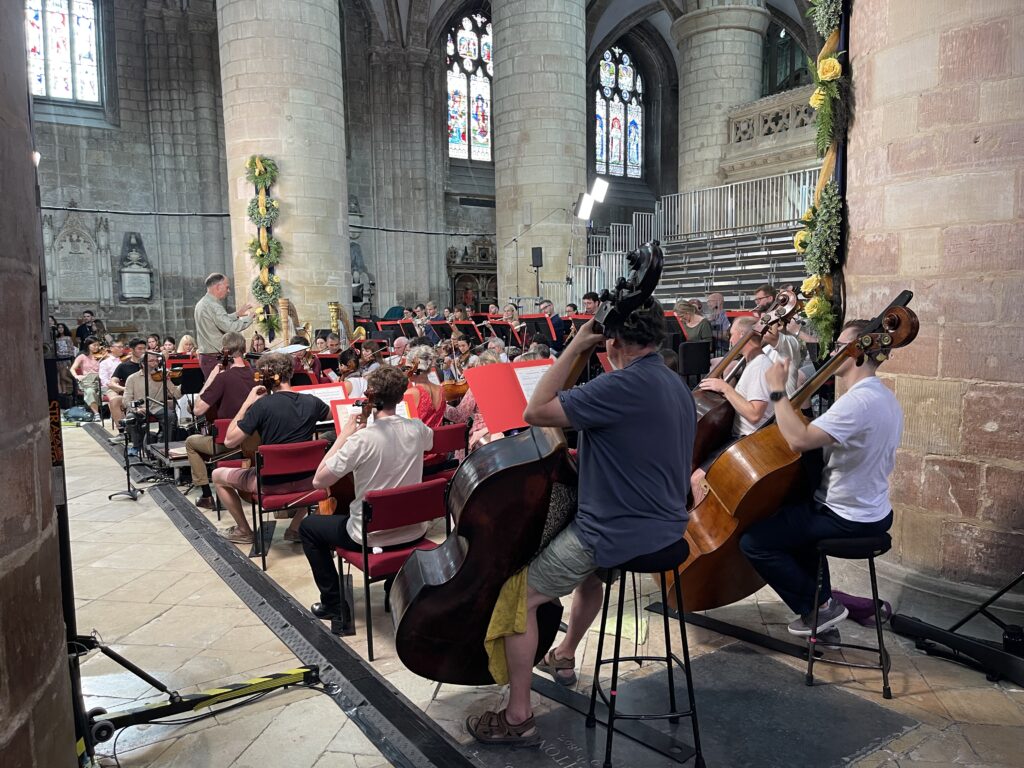
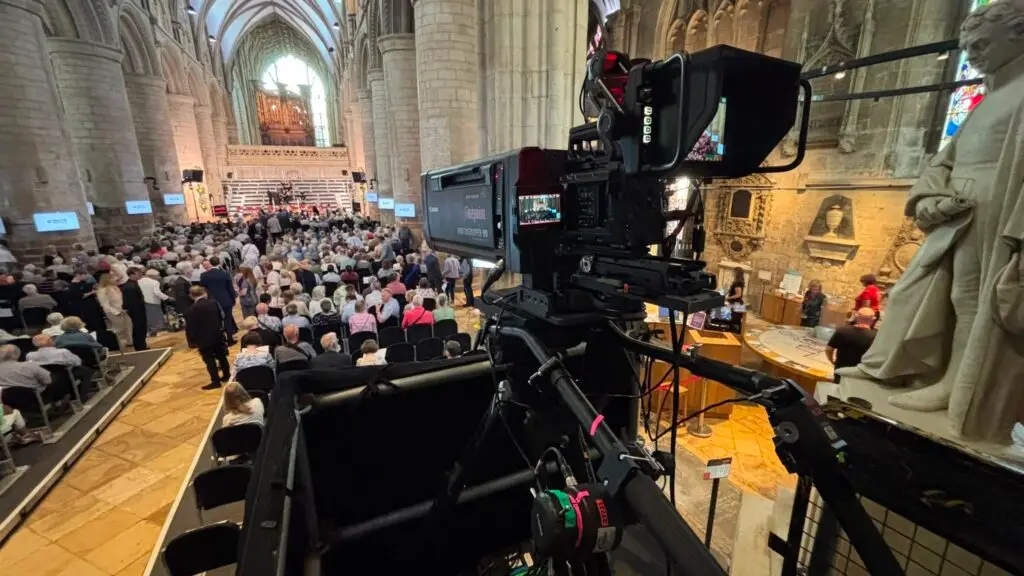
This was our fifth year providing live production support for the festival, working inside Gloucester Cathedral to help bring the performances closer to audiences throughout this remarkable historic venue.
Over the course of the festival, our four-person team worked behind the scenes to capture orchestras, choirs, conductors and soloists, producing live multi-camera coverage that was relayed to screens throughout the cathedral.
Now that the final performance is over and the equipment is packed away, we’ve brought together our series of behind-the-scenes films to show exactly what goes into filming classical music on this scale.
Watch: Behind the Scenes at Three Choirs Festival 2026
The film follows the Bubble Production team throughout the festival and introduces the different specialist roles involved in delivering the live coverage.
From reading the musical score to operating cameras high above the cathedral floor, each member of the team plays a very different part in the finished production.
Four People, One Live Production
One of the things that makes our Three Choirs Festival production unusual is just how compact the team is.
Four people are responsible for delivering the live pictures throughout the performances:
Music Director – follows the musical score and guides the Vision Director towards the important moments that are about to happen.
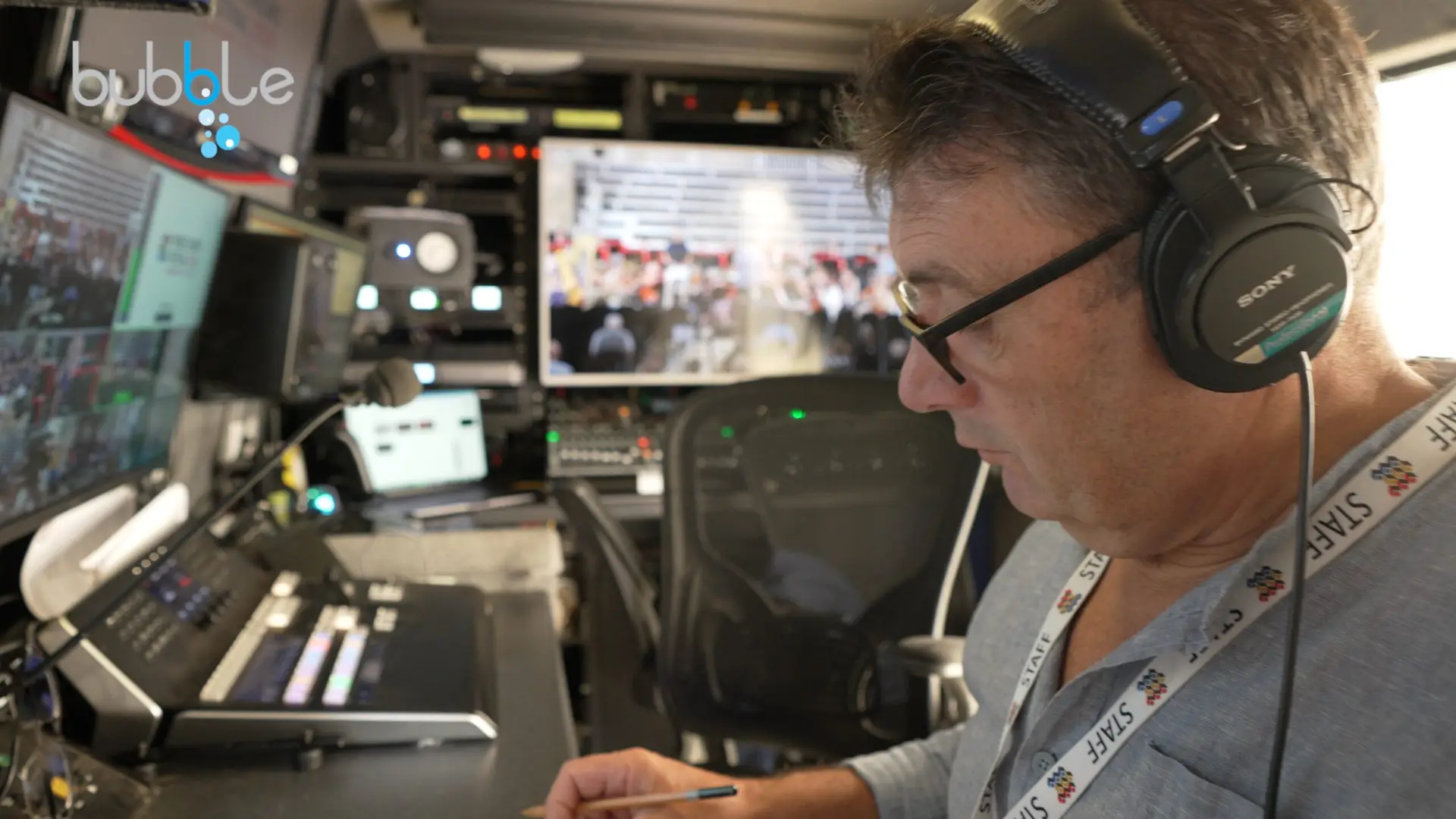
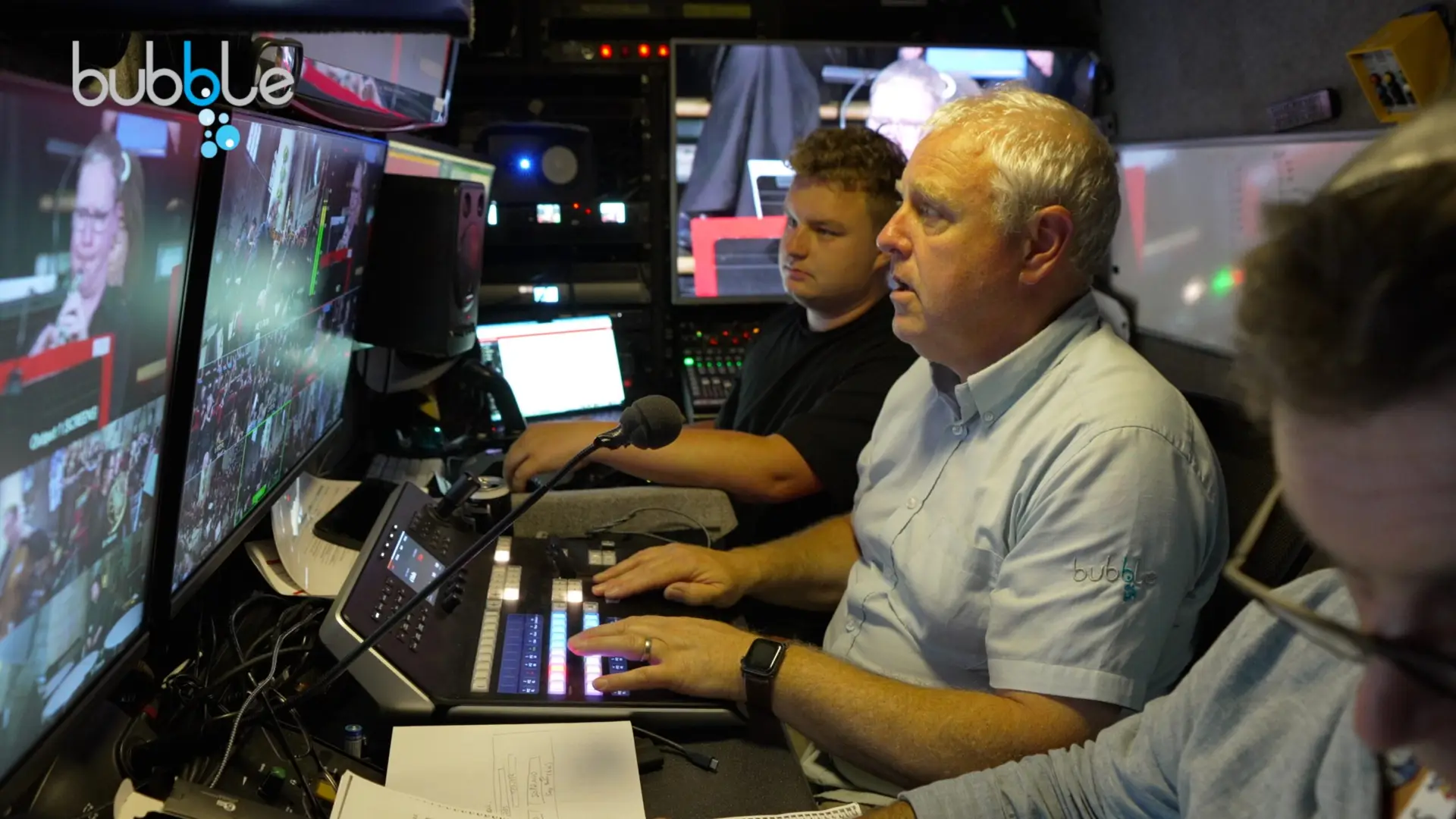
Vision Director – selects and cuts the camera shots, turning multiple individual camera feeds into one continuous live production.
Vision Engineer and PTZ Operator– looks after picture consistency and operates the remotely controlled cameras positioned around the cathedral.
Camera Operator – captures the performance from one of our principal manned camera positions, responding to direction while also finding the moments that help tell the story of the music.
Each role is different, but they have to work together continuously.
There are no second takes.
Filming Classical Music Is About Anticipation
Classical music presents a particular challenge for live production.
You cannot simply wait for something to happen and then point a camera towards it. By then, the moment may already have passed.
Before each performance, the musical score is prepared so our Music Director knows when important solos, instrumental passages and musical changes are approaching.
During the concert, the Music Director reads ahead of the performance and communicates with the Vision Director, allowing the next camera shot to be prepared before it is needed.
It means our coverage can move naturally with the music rather than constantly reacting to it.
For the audience, the process should be invisible. They simply see the right musician, soloist or section of the orchestra at the right moment.
Cameras Without the Clutter
Working inside Gloucester Cathedral also means respecting an extraordinary historic environment.
Our brief is to capture the performance without filling the stage and cathedral with cameras, operators and equipment.
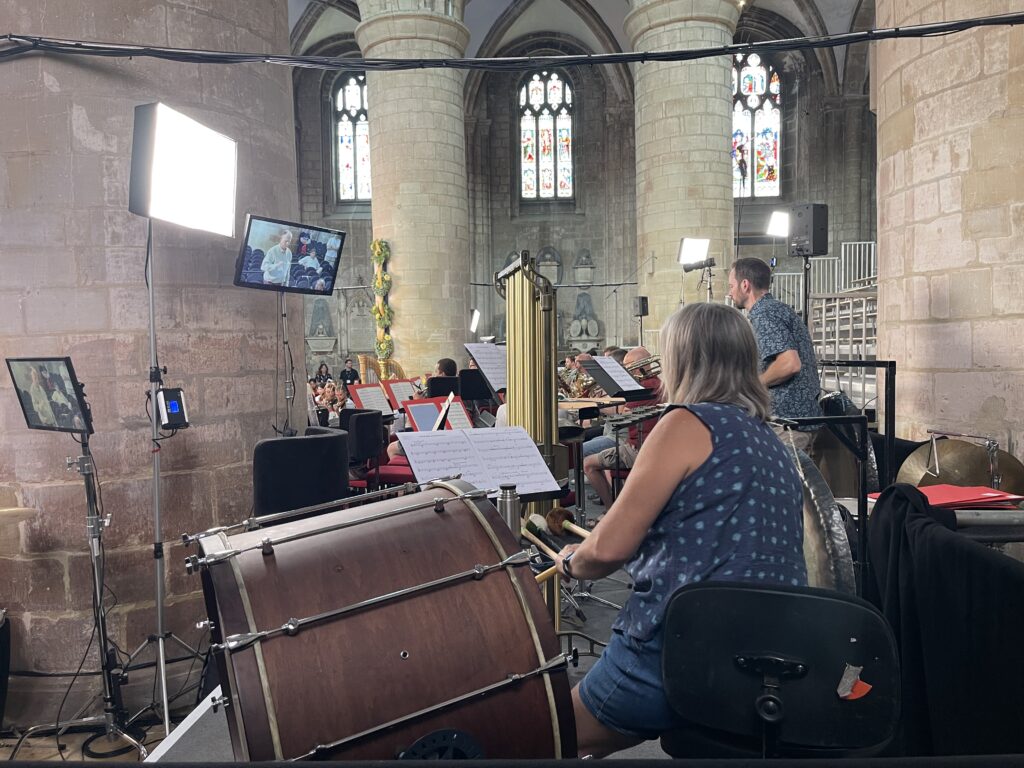
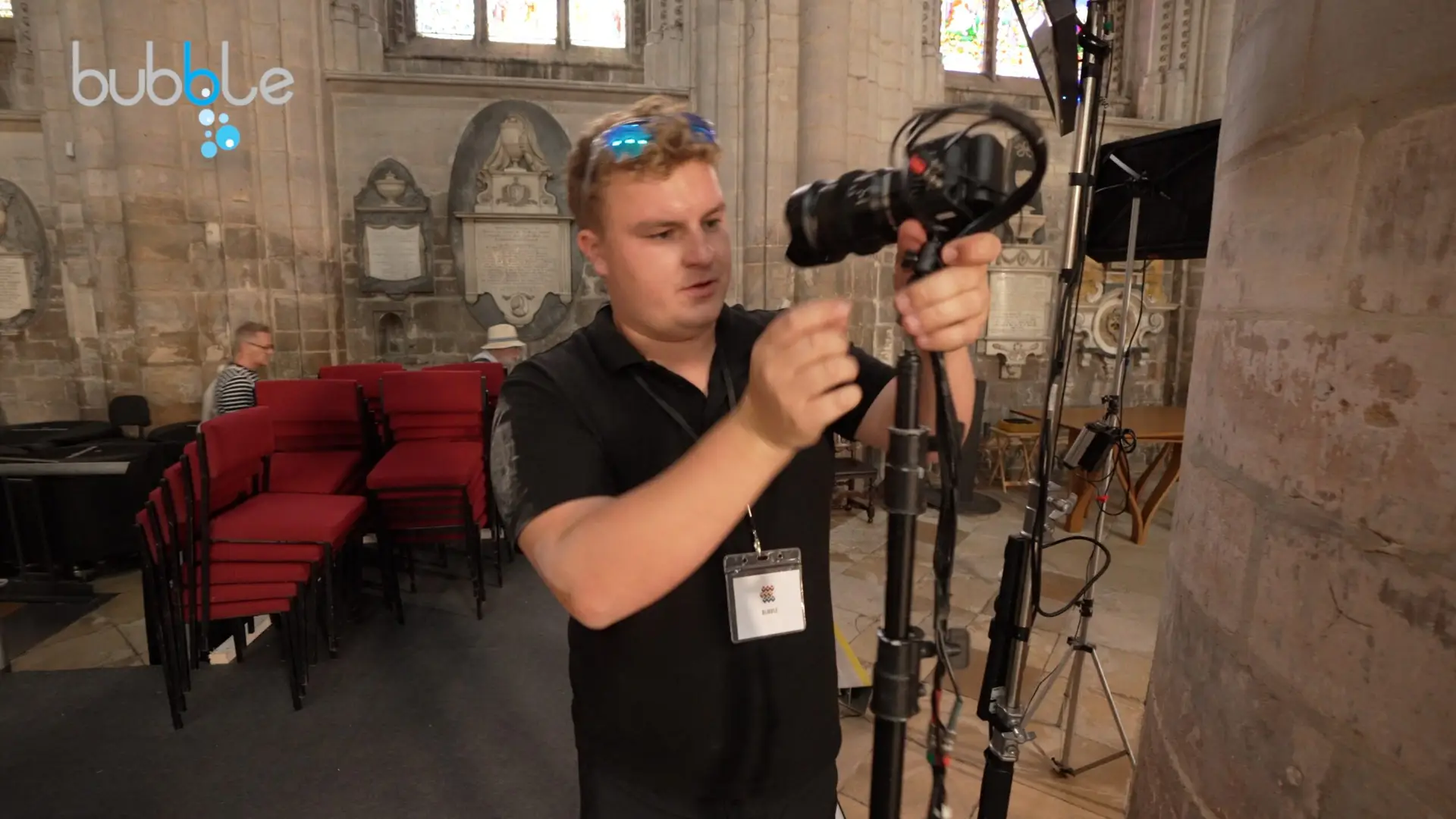
For Three Choirs Festival 2026, our camera system combined remotely operated PTZ cameras positioned high on the cathedral pillars with discreet micro cameras within the orchestra and our principal broadcast camera positions.
This gives the Vision Director a wide choice of shots while keeping the production footprint around the performers to a minimum.
The result can move from a wide view showing the scale of the cathedral and orchestra to a close-up of an individual musician within seconds.
The camera cannot simply move to the correct position at the moment the solo starts. By then, part of the musical phrase may already have passed.
Bringing the Performance to 30 Screens
The pictures aren’t being produced simply to create a recording.
They form an important part of the live audience experience.
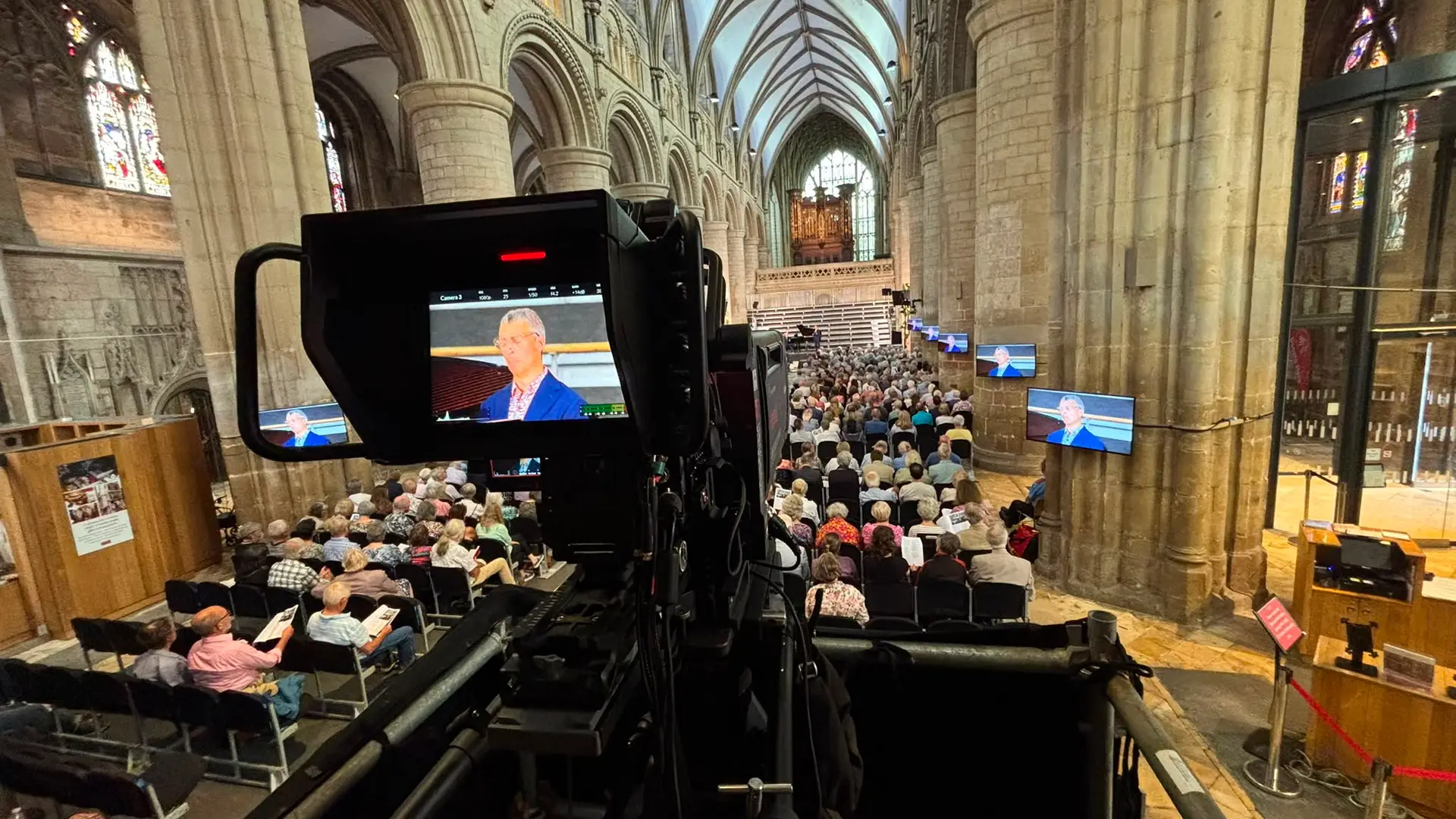
Our finished programme was distributed to 30 screens throughout Gloucester Cathedral, helping people in seats with restricted views follow the performance.
An additional 4 monitors are provided for performers with essential sightlines to the conductor.
That creates another important technical requirement: latency has to be virtually zero.
Even a small delay between the conductor’s movement and the image appearing on a monitor would make it unusable for musicians. Our video distribution system therefore has to deliver pictures around the cathedral effectively instantaneously.
Eight Days Behind the Screens
Audiences see the orchestra, choir and performers.
Behind those pictures is a small team spending eight days reading scores, directing cameras, matching pictures, operating PTZ heads and following every performance.
That’s exactly why we wanted to make this behind-the-scenes series.
The individual films have introduced each of those roles over the past few days. Our new film brings them together and gives a fuller picture of what happens behind the screens during Three Choirs Festival.
For us, it’s also a chance to recognise the people behind the production.
A huge thank you to the Bubble crew for another superb festival, and particularly to Jon Essex, who not only worked as part of the camera team but also created the profile films that have allowed us to share a little more of what happens behind the scenes.
And, of course, thank you to the Three Choirs Festival team for once again trusting Bubble Production to be part of such a special event.
Five years in, it’s a production we’re very proud to be involved with.
Need to Film a Classical Concert or Live Performance?
Bubble Production provides multi-camera classical music filming, live concert production, outside broadcast and big screen video relay for orchestras, festivals, venues and live events across the UK.
From historic cathedrals and concert halls to outdoor festivals, we can build a production around the performance and the venue – whether the requirement is live screens, streaming, recording or all three.
Talk to Bubble Production about your next live music production.
Filming a live orchestral performance requires more than technical skill and good camera work. To capture the right musician at the right moment, the production team must understand what is happening within the music—and what is about to happen next.
At Three Choirs Festival, this responsibility belongs to the music director.
Working from the full musical score, the music director guides the vision director through each performance. They identify important solos, choir entries, changes in instrumentation and significant musical moments, giving the production team the advance warning needed to prepare the appropriate camera shots.
It is a specialist role that combines musical knowledge, careful preparation and clear communication.
Meet the Team: Music Director, David Evans
In this type of production, the music director acts as the link between the musical score and the live television coverage.
The vision director is responsible for choosing the pictures that appear on the screens around the cathedral. However, with a large orchestra, choir, conductor and soloists all involved, it is impossible to anticipate every important moment by watching the stage alone.
The music director follows the score throughout the concert and advises the vision director about what is coming next.
This might include a violin solo, an important woodwind passage, the entrance of a choir section or a change in focus between the orchestra and conductor. The information allows the vision director to instruct the relevant camera operator and prepare the shot before the musical moment begins.
Without this advance guidance, a short solo or instrumental entry could easily be missed.
Preparing the Musical Score
The music director’s work begins well before the performance.
Each score must be studied and carefully marked with the moments that will be most useful to the visual production. These markings may identify individual instruments, soloists, choir entries, conductor cues and changes in the structure or pace of the music.
The music director must decide which moments are visually important as well as musically significant.
Not every change in the score needs to result in a camera cut. The purpose is to help the pictures complement the music rather than create unnecessary movement on screen.
This preparation gives the production a clear visual roadmap while still allowing the team to respond naturally to the live performance.
Reading the Score in Real Time
During the concert, the music director follows the printed score bar by bar.
This requires complete concentration. A large orchestral score may contain separate lines for every section of the orchestra, the choir and any featured soloists. The director must keep their place while listening closely to the performance and anticipating the next marked cue.
The timing must be precise.
If an instrumental solo begins in ten seconds, the vision director needs enough warning to contact the appropriate camera operator, locate the musician and prepare a well-composed shot.
The camera cannot simply move to the correct position at the moment the solo starts. By then, part of the musical phrase may already have passed.
The music director therefore needs to remain several steps ahead.
Guiding the Vision Director
Throughout the performance, the music director communicates directly with the vision director.
The instructions are usually short and specific. They may identify an approaching solo, a particular section of the choir or an important moment involving the conductor.
The vision director then translates this musical information into camera instructions.
For example, the music director may indicate that the oboe is about to become prominent. The vision director can then ask one camera operator to prepare a close-up of the oboist while keeping another suitable shot available on screen.
Once the new shot is correctly framed and ready, the vision director can select it at the appropriate point in the music.
This close working relationship allows the production to follow the performance with accuracy and confidence.
From Musical Cue to Live Picture
Every picture shown on screen is the result of several people working together.
The music director identifies the upcoming musical moment. The vision director decides how it should be covered and assigns a camera. The camera operator finds and frames the subject, while the vision engineer checks that the picture is correctly exposed and matched with the other cameras.
The vision director then decides exactly when to use the shot.
This entire process may happen within a matter of seconds.
When it works well, the audience sees a natural visual interpretation of the music: the featured instrument appears as its solo begins, the conductor is shown at an important cue, or the picture widens as the full orchestra and choir come together.
The technical process remains invisible, allowing the audience to concentrate on the performance.
Understanding the Shape of the Music
The music director does more than identify individual instruments.
They also help the vision director understand the overall structure and character of the performance. The score reveals how the music builds, where it becomes quieter, when themes return and how different sections interact.
This information helps shape the pace of the camera coverage.
A dramatic and energetic passage may suit a sequence of shorter shots, moving between the conductor, orchestra and choir. A slower or more reflective section may be better served by longer, steadier images.
The music director can also indicate when an important musical transition is approaching, allowing the vision director to prepare a wider shot or change the visual emphasis.
The result is camera direction that follows the emotion and rhythm of the performance rather than simply showing a series of technically correct pictures.
Working With a Large Orchestra and Choir
A major choral concert may involve hundreds of performers.
From the production position, it is not always easy to identify individual musicians or see which section is creating a particular sound. Some instruments may also be partially obscured by other performers, music stands or the layout of the stage.
The marked score provides the information needed to navigate this complex visual environment.
The music director can identify exactly which instrument or voice is about to become important. The vision director can then choose the camera with the clearest view or ask a PTZ robotic camera operator to prepare an alternative angle.
Careful planning is particularly important when a solo lasts only a few bars. Every member of the production team must be ready before it begins.
Responding to a Live Performance
Although the score provides a detailed guide, every live performance is slightly different.
Conductors may choose a different tempo, soloists may hold a note for longer, and pauses between movements may vary. The music director must follow the performance itself rather than relying only on the expected timing.
They listen for musical landmarks and watch the conductor to ensure the production remains aligned with what is happening on stage.
If the orchestra moves through a passage faster than anticipated, the music director must adjust immediately. Instructions to the vision director need to remain accurate, concise and early enough to be useful.
This ability to combine score reading with active listening is a key part of the role.
Supporting the Audience Experience
At Three Choirs Festival, the live pictures are relayed to screens positioned throughout the cathedral.
These screens help audience members in restricted-view seats see the conductor, soloists, choir and individual orchestral players. They also allow everyone in the venue to appreciate details that may be difficult to see from a distance.
The music director helps ensure that the pictures show the most relevant part of the performance at the right time.
When a soloist begins, the audience can see them. When the conductor brings in a new section, the screens can reveal that moment. When the full orchestra and choir reach a musical climax, the visual coverage can reflect its scale.
The aim is not to turn the concert into a television programme that competes with the live experience. It is to use the cameras to help the audience engage more closely with the music.
A Specialist Role Within the Production Team
The music director’s work often takes place away from the cameras and outside the audience’s view, but it influences almost every shot selected during the concert.
The role requires detailed musical knowledge, the ability to read complex orchestral scores and an understanding of how music can be translated into pictures.
It also requires calm and precise communication. Instructions must be delivered clearly without distracting the vision director from the many other elements of the live production.
Together, the music director and vision director create a visual interpretation of the performance in real time.
Completing Our Behind-the-Scenes Series
This film completes our behind-the-scenes series from Three Choirs Festival, looking at the different people and skills involved in delivering the live production.
We have followed the work of the camera operator, the vision director, and the vision engineer and PTZ robotic camera operator. In this final film, we explore the role of the music director and the specialist knowledge required to guide the cameras through a live orchestral score.
Our thanks go to Jon Essex for creating the films and helping us share the work of the production team.
Professional Multi-Camera Filming for Orchestral Performances
Bubble Production provides experienced music directors, vision directors, camera crews and complete multi-camera production facilities for orchestral concerts, choirs, festivals and live music events.
Our teams have extensive experience filming performances in cathedrals, concert halls, historic buildings and outdoor venues. We can provide live relay to venue screens, professional recording, live streaming and outside broadcast facilities.
By combining musical knowledge with experienced camera direction and broadcast technology, we create coverage that follows the score, captures important moments and supports the live audience experience.
To discuss live orchestral filming, multi-camera concert production or venue screen coverage for your next event, contact Bubble Production.
A successful live production depends on every camera producing clear, consistent and reliable pictures. While camera operators and the vision director concentrate on capturing the performance, the vision engineer works behind the scenes to ensure the technical quality of those images remains consistent throughout the concert.
At Three Choirs Festival, the role also includes operating the PTZ robotic cameras positioned around the cathedral.
This combination of technical engineering and remote camera operation requires concentration, precision and a detailed understanding of live multi-camera production.
Meet the Team: Vision Engineer, George Tarplee
The vision engineer is responsible for maintaining the technical quality of every camera used in the production.
Different camera positions can produce noticeably different pictures. One camera may be facing a brightly lit soloist, while another is looking across a darker area of the choir or orchestra. Light levels may also change as performers move or as the natural light inside the cathedral alters during the day.
The vision engineer monitors every camera and makes continuous adjustments to ensure the pictures match as closely as possible.
This includes managing exposure, colour balance, contrast, black levels and other camera settings. The aim is to create a consistent visual appearance so that the audience is not distracted by sudden changes when the vision director cuts from one camera to another.
Matching Multiple Cameras
Multi-camera productions often use a mixture of camera types.
At Three Choirs Festival, the system includes operated broadcast cameras, PTZ robotic cameras and small fixed cameras positioned within the orchestra. Each type of camera has different characteristics, lenses and operating positions.
The vision engineer must bring these different sources together and make them look like part of the same production.
This process is often known as camera matching or camera shading. It involves making careful adjustments throughout the performance rather than setting the cameras once and leaving them unchanged.
A musician dressed in white may enter a bright pool of light. A camera may move from a darker part of the cathedral to the main stage. A close-up may expose differences that were not noticeable in a wide shot.
The vision engineer must anticipate and correct these changes in real time.
Working With the Vision Director
The vision engineer works closely with the vision director throughout the concert.
While the director concentrates on selecting shots and following the musical score, the engineer ensures each available picture is technically ready to be used.
Communication between the two roles is essential. The vision director may warn the engineer that a particular camera is about to be selected, allowing any final adjustments to be made before it appears on screen.
The vision engineer must also keep track of cameras that are moving, reframing or preparing for a new shot. A technically poor image can limit the director’s options, so every camera needs to remain ready whenever possible.
Operating PTZ Robotic Cameras
PTZ stands for pan, tilt and zoom. A PTZ camera can be moved and controlled remotely rather than requiring a camera operator to stand beside it.
At Three Choirs Festival, PTZ cameras are mounted high on the cathedral pillars. These elevated positions provide clear views across the choir, orchestra and performance area without taking up valuable floor space or blocking the audience’s view.
The PTZ operator controls these cameras from the production area using a remote control panel.
The operator can move the camera horizontally, tilt it vertically, adjust the zoom and recall previously prepared camera positions. This makes it possible to capture a wide range of shots from locations that would be difficult or impractical for a conventional camera operator.
More Than Pressing a Preset
PTZ cameras can store preset positions, but successful robotic camera operation involves far more than simply pressing a button.
Each preset needs to be prepared carefully. The framing must take account of the musician’s position, the instrument being played and the surrounding performers. The operator also needs to consider whether someone may move into the shot or obscure the subject.
During the performance, presets may need to be adjusted. Musicians do not always sit or stand in exactly the same position, and soloists may move unexpectedly.
The PTZ operator must therefore monitor the live camera feeds and make small corrections when necessary.
Movements also need to be smooth and controlled. Sudden pans, fast zooms or poorly timed repositioning can be distracting and may make a camera temporarily unusable.
Following the Performance Remotely
Like the camera operators and vision director, the PTZ operator must understand what is happening musically.
The operator may be asked to find a particular section of the orchestra, prepare a close-up of the choir or move to a shot of the conductor. These instructions often need to be completed before the vision director is ready to use the camera.
A musical moment may last only a few seconds.
The operator must locate the subject, adjust the composition and confirm that the shot is stable and correctly exposed. At the same time, the vision engineer must ensure the image matches the other cameras.
This makes the combined role particularly demanding. It requires both creative camera awareness and technical attention to picture quality.
Using Cameras Discreetly in a Cathedral
Historic venues require a sensitive approach to camera placement.
Large camera platforms and operators cannot be positioned everywhere without affecting audience sightlines or the appearance of the venue. PTZ cameras provide an effective way to obtain additional angles while keeping the production footprint relatively small.
Mounted high on the pillars, the cameras can remain discreet while offering useful views of the performers and conductor.
The operator can control several robotic cameras from one position, allowing the production to cover more of the performance without placing additional crew around the cathedral.
This is particularly useful for live screen relay, where audiences in restricted-view seats need reliable close-ups and alternative views of the stage.
Maintaining Consistency Throughout the Concert
A concert can last for several hours, and concentration must remain high from beginning to end.
The vision engineer continually checks each camera for changes in exposure, colour and focus. The PTZ operator must also ensure that robotic camera positions remain accurate and useful as the performance develops.
Small technical differences can become very noticeable on large screens.
A camera that is slightly too bright, too dark or different in colour can disrupt the visual flow of the production. Careful engineering helps make every cut feel seamless.
The goal is for the audience to concentrate on the performance rather than the technology used to capture it.
Responding to Technical Challenges
Live production always brings the possibility of unexpected problems.
A camera may lose its intended position, a performer may move out of frame or changing light levels may alter the appearance of a shot. The vision engineer and PTZ operator must respond quickly without interrupting the programme.
There is rarely time for lengthy troubleshooting during a live concert.
The operator needs to identify the issue, make the necessary adjustment and return the camera to the director as quickly as possible. Having backup shots and alternative camera positions helps the team maintain continuous coverage.
Experience, preparation and calm decision-making are essential.
The Team Behind the Pictures
As part of our behind-the-scenes series from Three Choirs Festival, we are profiling the people responsible for delivering the live production.
In this film, we look at the combined role of the vision engineer and PTZ robotic camera operator.
It is a role that brings together camera engineering, remote operation and close teamwork with the vision director and camera crew. Although much of the work takes place away from the audience, it has a major impact on the quality of every picture shown around the cathedral.
Our thanks go to Jon Essex for creating the films in this series and helping us share the work of the production team.
Professional Vision Engineering and PTZ Camera Operation
Bubble Production provides experienced vision engineers, PTZ camera operators and complete multi-camera production facilities for concerts, festivals, conferences, sporting events and live broadcasts.
Our systems can combine operated cameras, robotic cameras and fixed camera positions, with live pictures delivered to venue screens, online audiences or recorded for future use.
From matching camera pictures and managing exposure to remotely framing musicians and soloists, our team handles the technical detail needed to produce a consistent and professional programme.
To discuss PTZ camera operation, vision engineering or multi-camera filming for your next event, contact Bubble Production.
Filming a live orchestral performance requires much more than a collection of cameras. Someone must bring all those pictures together, choose the right shot at the right moment and ensure the visual production follows the music naturally.
That responsibility belongs to the vision director.
At this year’s Three Choirs Festival, Bubble Production is once again providing live multi-camera coverage for performances inside the cathedral. The pictures are relayed in real time to screens throughout the venue, helping audience members with restricted views follow the conductor, soloists, choir and orchestra.
At the centre of the production is the vision director, coordinating the camera team and shaping the way the audience sees the performance.
Meet the Team: Vision Director, Graham Essenhigh
The vision director is responsible for selecting the camera shots used during a live production.
Each camera provides a different view of the performance. These may include wide shots of the stage, close-ups of the conductor, individual musicians, soloists, choir sections and architectural views of the cathedral.
The vision director watches all these camera feeds simultaneously and decides which picture should appear on screen.
During a live orchestral concert, these decisions must be made instantly. There is no opportunity to pause the performance or repeat a section. Every cut needs to feel natural, reflect what is happening musically and help the audience engage with the concert.
Following the Musical Score
Directing an orchestral performance is very different from directing many other types of live event.
At Three Choirs Festival, the vision director works closely with the music director who guides him from a specially prepared and marked musical score. This helps identify important moments before they happen, including instrumental solos, changes between sections, choir entrances and significant conductor cues.
The music director reads the score which allows the vision director to concentrate on the images and to plan ahead rather than simply react.
As the music progresses, the vision director can prepare the appropriate camera operator, request a particular shot and ensure it is framed correctly before selecting it for the live output.
A solo may last only a few bars. Without preparation, the moment could easily be missed.
This combination of musical understanding, concentration and live production experience is essential when filming orchestral performances.
Communicating With the Camera Team
The vision director is in continuous communication with the camera operators throughout the concert.
Using a talkback system, the director gives clear instructions about which musicians, instruments or areas of the stage each camera should cover. Operators may be asked to prepare a close-up, widen their shot, follow a soloist or hold a particular composition ready for use.
Good communication needs to be calm, precise and timely.
The director must give camera operators enough notice to find and compose the shot without filling their headsets with unnecessary information. At the same time, the instructions must be clear enough for every member of the team to understand what is required.
The camera operators also use their own initiative, anticipating useful shots and responding to unexpected moments. This provides the vision director with a range of strong pictures from which to choose.
Creating a Visual Rhythm
A successful live music production should complement the performance rather than distract from it.
The vision director needs to understand when to change shots and when to allow an image to remain on screen. Fast cutting may suit a lively and energetic passage, while a slower section may benefit from longer, more considered shots.
Not every musical beat requires a camera change.
The visual rhythm should follow the shape, pace and atmosphere of the music. A carefully timed close-up of a soloist can highlight an important moment, while a wide shot can show the scale of the orchestra, choir and cathedral setting.
The best vision directing often goes unnoticed. The audience is drawn further into the performance without becoming overly aware of the technical decisions taking place behind the scenes.
Managing Multiple Camera Sources
The Three Choirs Festival production uses a combination of operated cameras, remotely controlled PTZ cameras and small fixed cameras positioned within the orchestra.
Each source offers a different perspective.
The vision director monitors all available pictures and builds the programme using the strongest shots. One camera may be focused on the conductor, another on a soloist, while other cameras cover the choir, orchestra sections or wider views of the performance space.
While one camera is live, the director is already preparing the next shot.
This requires constant awareness. The director must know which cameras are available, which are repositioning and which are ready to be selected. Every transition needs to be smooth, particularly when the pictures are being displayed live on screens around the cathedral.
Responding to the Unexpected
Although the musical score provides a detailed guide, live performances can still be unpredictable.
A performer may move unexpectedly, a soloist may stand earlier than anticipated or a camera position may temporarily become unavailable. The director must respond immediately while maintaining the flow of the production.
Experience plays a major part in this.
A skilled vision director remains calm, adapts quickly and always has an alternative shot available. The audience should never be aware that anything unexpected has happened.
This ability to solve problems in real time is one of the most important aspects of live vision directing.
Live Production Inside a Cathedral
Directing a concert inside a cathedral presents additional visual challenges.
The production must capture both the detail of the performance and the scale of the historic venue. Lighting levels can vary across the stage and surrounding architecture, while camera positions must be chosen carefully to avoid affecting the audience or performers.
The vision director works closely with the camera operators and vision engineer to maintain a consistent look across every camera.
The result is a live production that allows the audience to see details that may not be visible from their seats, while still preserving the atmosphere of attending a concert inside the cathedral.
Professional Vision Directing and Multi-Camera Production
Bubble Production provides experienced vision directors, camera crews and complete multi-camera production facilities for concerts, festivals, conferences, sporting events and live broadcasts across the UK.
Our portable production units and outside broadcast facilities can support live streaming, event recording and real-time relay to screens around a venue.
Whether working from a musical score, a running order or a live event schedule, our production teams combine technical knowledge with the experience needed to capture important moments as they happen.
To discuss vision directing, live event filming or multi-camera production for your next event, contact the Bubble Production team.