Filming a live orchestral performance requires much more than a collection of cameras. Someone must bring all those pictures together, choose the right shot at the right moment and ensure the visual production follows the music naturally.
That responsibility belongs to the vision director.
At this year’s Three Choirs Festival, Bubble Production is once again providing live multi-camera coverage for performances inside the cathedral. The pictures are relayed in real time to screens throughout the venue, helping audience members with restricted views follow the conductor, soloists, choir and orchestra.
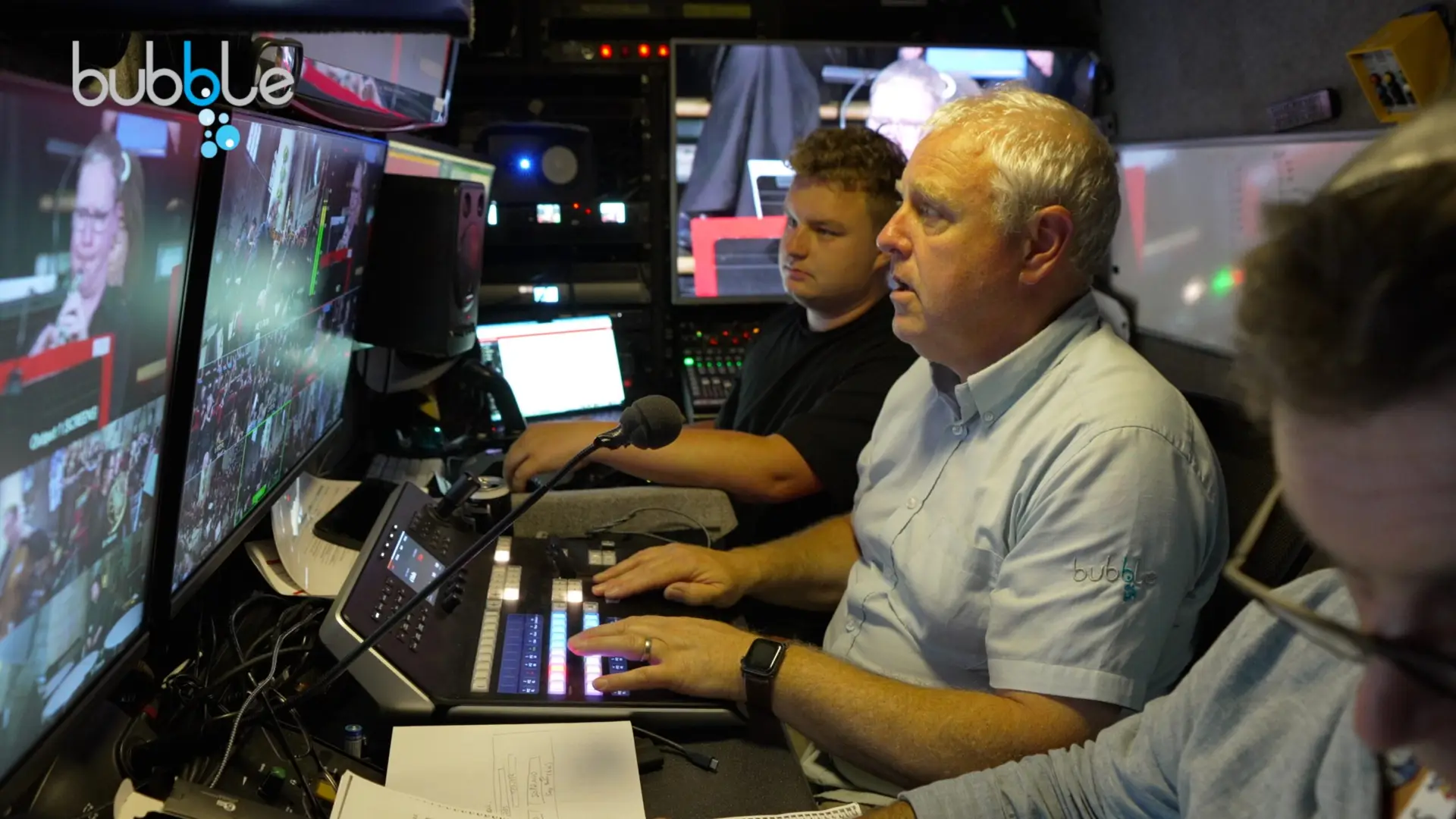
At the centre of the production is the vision director, coordinating the camera team and shaping the way the audience sees the performance.
Meet the Team: Vision Director, Graham Essenhigh
The vision director is responsible for selecting the camera shots used during a live production.
Each camera provides a different view of the performance. These may include wide shots of the stage, close-ups of the conductor, individual musicians, soloists, choir sections and architectural views of the cathedral.
The vision director watches all these camera feeds simultaneously and decides which picture should appear on screen.
During a live orchestral concert, these decisions must be made instantly. There is no opportunity to pause the performance or repeat a section. Every cut needs to feel natural, reflect what is happening musically and help the audience engage with the concert.
Following the Musical Score
Directing an orchestral performance is very different from directing many other types of live event.
At Three Choirs Festival, the vision director works closely with the music director who guides him from a specially prepared and marked musical score. This helps identify important moments before they happen, including instrumental solos, changes between sections, choir entrances and significant conductor cues.
The music director reads the score which allows the vision director to concentrate on the images and to plan ahead rather than simply react.
As the music progresses, the vision director can prepare the appropriate camera operator, request a particular shot and ensure it is framed correctly before selecting it for the live output.
A solo may last only a few bars. Without preparation, the moment could easily be missed.
This combination of musical understanding, concentration and live production experience is essential when filming orchestral performances.
Communicating With the Camera Team
The vision director is in continuous communication with the camera operators throughout the concert.
Using a talkback system, the director gives clear instructions about which musicians, instruments or areas of the stage each camera should cover. Operators may be asked to prepare a close-up, widen their shot, follow a soloist or hold a particular composition ready for use.
Good communication needs to be calm, precise and timely.
The director must give camera operators enough notice to find and compose the shot without filling their headsets with unnecessary information. At the same time, the instructions must be clear enough for every member of the team to understand what is required.
The camera operators also use their own initiative, anticipating useful shots and responding to unexpected moments. This provides the vision director with a range of strong pictures from which to choose.
Creating a Visual Rhythm
A successful live music production should complement the performance rather than distract from it.
The vision director needs to understand when to change shots and when to allow an image to remain on screen. Fast cutting may suit a lively and energetic passage, while a slower section may benefit from longer, more considered shots.
Not every musical beat requires a camera change.
The visual rhythm should follow the shape, pace and atmosphere of the music. A carefully timed close-up of a soloist can highlight an important moment, while a wide shot can show the scale of the orchestra, choir and cathedral setting.
The best vision directing often goes unnoticed. The audience is drawn further into the performance without becoming overly aware of the technical decisions taking place behind the scenes.
Managing Multiple Camera Sources
The Three Choirs Festival production uses a combination of operated cameras, remotely controlled PTZ cameras and small fixed cameras positioned within the orchestra.
Each source offers a different perspective.
The vision director monitors all available pictures and builds the programme using the strongest shots. One camera may be focused on the conductor, another on a soloist, while other cameras cover the choir, orchestra sections or wider views of the performance space.
While one camera is live, the director is already preparing the next shot.
This requires constant awareness. The director must know which cameras are available, which are repositioning and which are ready to be selected. Every transition needs to be smooth, particularly when the pictures are being displayed live on screens around the cathedral.
Responding to the Unexpected
Although the musical score provides a detailed guide, live performances can still be unpredictable.
A performer may move unexpectedly, a soloist may stand earlier than anticipated or a camera position may temporarily become unavailable. The director must respond immediately while maintaining the flow of the production.
Experience plays a major part in this.
A skilled vision director remains calm, adapts quickly and always has an alternative shot available. The audience should never be aware that anything unexpected has happened.
This ability to solve problems in real time is one of the most important aspects of live vision directing.
Live Production Inside a Cathedral
Directing a concert inside a cathedral presents additional visual challenges.
The production must capture both the detail of the performance and the scale of the historic venue. Lighting levels can vary across the stage and surrounding architecture, while camera positions must be chosen carefully to avoid affecting the audience or performers.
The vision director works closely with the camera operators and vision engineer to maintain a consistent look across every camera.
The result is a live production that allows the audience to see details that may not be visible from their seats, while still preserving the atmosphere of attending a concert inside the cathedral.
Professional Vision Directing and Multi-Camera Production
Bubble Production provides experienced vision directors, camera crews and complete multi-camera production facilities for concerts, festivals, conferences, sporting events and live broadcasts across the UK.
Our portable production units and outside broadcast facilities can support live streaming, event recording and real-time relay to screens around a venue.
Whether working from a musical score, a running order or a live event schedule, our production teams combine technical knowledge with the experience needed to capture important moments as they happen.
To discuss vision directing, live event filming or multi-camera production for your next event, contact the Bubble Production team.
Take a look at the other profile films following our work at Three Choirs Festival here: https://bubbleproduction.co.uk/live-streaming-insights/